
Biotech Startup Funding: Legal Checklist for Founders Seeking Venture Capital, Grants or Angel Investment
Biotech startup funding is beginning to recover after several difficult years, but the market has not returned to an easy-money environment.
Healthcare venture investment rose to $60 billion across 2,167 deals in 2025, up from $54 billion in 2024. That means more capital is returning to the market, but it is not being spread indiscriminately.
For founders, the message is clear: investors are still selective. Capital is moving toward companies that can connect each funding round to a concrete value inflection point.
This article explains how biotech startups can prepare for venture capital, grants, angel investment and investor diligence before funding conversations expose legal or operational gaps.
What Is Biotech Startup Funding?
Biotech startup funding is the capital that moves your company from research promise to a proof point someone else can evaluate. In biotech, that proof point comes before revenue, regulatory approval and before the company has a complete clinical story.
That is why you should not treat the money as a general runway.
The U.S. Department of Health and Human Services reports that the clinical phase of drug development averages about 95 months, compared with about 31 months for the nonclinical phase. Put plainly, that is nearly eight years in clinical development after more than two and a half years of nonclinical work. Clinical trials account for about 69 percent of overall research and development costs.
Those numbers change the funding conversation because you are asking investors to fund the next credible step in a long and complex development path.
A funding round may need to pay for:
- Preclinical studies or clinical trials
- Patent filings and invention assignments
- Regulatory consultants
- Data room preparation
- Manufacturing planning
- Market analysis for a future strategic partner
Each expense should point to a decision the company can defend. Toxicology work should answer a development question. Patent filings should protect the lead asset. Regulatory planning should help reduce uncertainty before the next investor diligence review.
The same discipline applies to risk.
Another report found that the likelihood of approval from Phase I was 7.9 percent across all modalities from 2011 through 2020. Biologics had a 9.1 percent likelihood of approval, compared with 5.7 percent for new molecular entities.
Those odds explain why potential investors look past the pitch deck. They want to see whether the company’s records, data and business plan support the next funding round.
Investors may ask whether the funding will help the company:
- Produce stronger preclinical data
- Support an Investigational New Drug (“IND”) submission
- Clarify intellectual property ownership
- Improve Chemistry, Manufacturing and Controls (“CMC”) readiness
- Resolve a regulatory question
- Make the company easier to diligence by a larger investor, strategic partner or potential acquirer
Biotech Startup Funding Options for Early-Stage Founders
Funding choice matters in a selective biotech market. J.P. Morgan reported that Q1 2026 biopharma venture funding fell to $6.9 billion across 101 deals, down from $8.6 billion in Q1 2025, with investors concentrating around later-stage assets, differentiated science and clearer clinical and commercial pathways.
The right source of capital should match your company’s next milestone, whether that milestone is early validation, preclinical work, intellectual property protection, regulatory planning, manufacturing readiness or strategic partnership preparation.
Common biotech startup funding options include:
- Angel investment for early validation, formation expenses and initial research planning.
- Venture capital for larger milestones tied to preclinical data, clinical development, regulatory progress or commercialization.
- Federal grants, including Small Business Innovation Research (“SBIR”) and Small Business Technology Transfer (“STTR”) funding, for research and development work that fits the company’s commercial roadmap.
- State incentives and tax programs that may help extend runway or support growth in a specific jurisdiction.
- University licenses, sponsored research agreements and collaborations that may provide access to intellectual property, facilities or scientific expertise.
- Strategic partnerships or licensing arrangements that can provide capital, validation or development support without relying only on equity financing.
Biotech Moat Explained: What Biotech Investors Really Look for Before Funding a Startup
In Q1 2026, median venture round sizes were $40 million for platform companies, $39 million for preclinical companies, $34 million for Phase I companies, $73 million for Phase II companies and $108 million for Phase III companies.
Those numbers show how funding follows proof. As a biotech company moves from platform or preclinical work into later clinical stages, investors start paying for reduced uncertainty around your science and technology.
That is where the idea of a biotech moat becomes important. A moat is the defensible position that makes a company’s asset, platform or technology harder for another company to copy, block, design around or commercialize first.
Components of a Biotech Moat
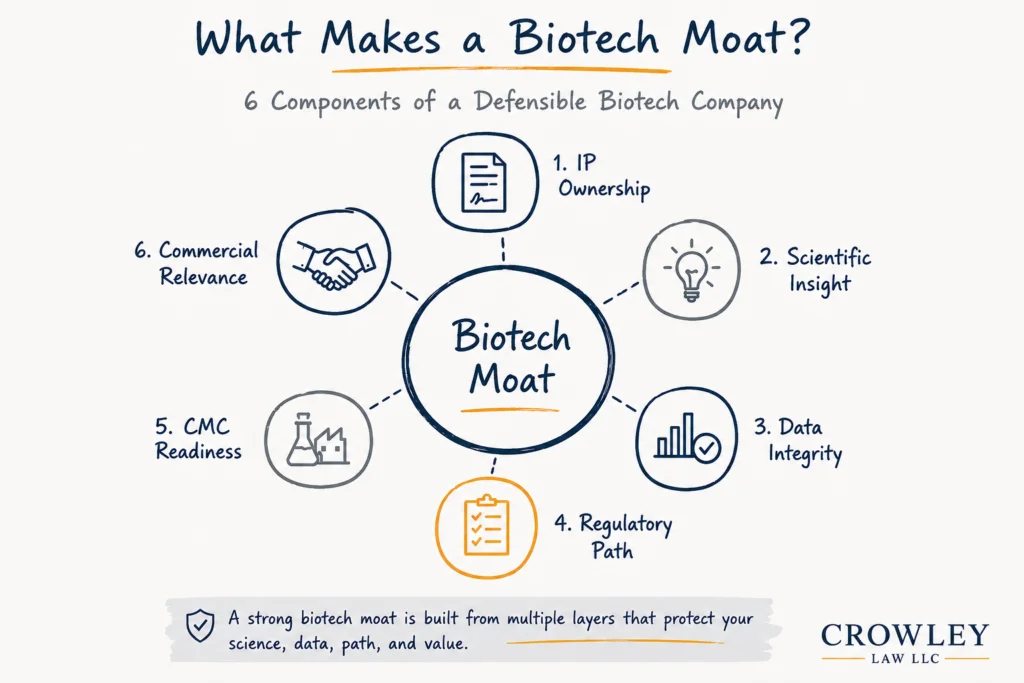
Intellectual Property Moat
An intellectual property moat is the legal and practical protection around the asset that gives your biotech startup its value. Potential investors ask whether your startup can stop, slow or force a costly workaround if a well-funded competitor targets the same opportunity.
The investor stress test is direct:
- Can you develop without obvious third-party patent risk?
- Does the company clearly own or control the core asset?
- Do the patent applications contain enough technical detail to support the claims?
- Which filings are the true “crown jewels” and which are supporting protections?
- Could a competitor design around the claims with small changes?
- Could the claim language withstand close diligence review?
- Are trade secrets, datasets, protocols and know-how protected by real controls?
If this layer is weak, investor diligence can quickly shift from excitement about the asset to concern about whether the company controls what the funding round is supposed to advance.
Scientific Insight Moat
Scientific insight becomes a moat when you can explain why your target, intervention and patient population fit together. Novel science is not enough if you cannot show how the biology turns into a credible drug development path.
Before you fundraise, be ready to explain:
- How large is the market – in the USA and worldwide
- Why the target matters in the disease
- Whether the target should be inhibited, activated, replaced or corrected
- Why your modality fits the biology
- What proof-of-concept readout would confirm or weaken your thesis
Your scientific moat is the logic chain behind the program. If that chain is unclear, investors may see an interesting experiment rather than a company ready for serious funding.
Data Integrity
Data integrity is the claim-to-record test. An investor should be able to move from a statement in the pitch deck to the underlying protocol, assay, sample, control, timestamp, operator and original record without relying on your memory.
That means your diligence file should show:
- Who generated the data, when and under what protocol
- Whether the same result appears across repeats, models or independent validation
- Whether controls, exclusions and failed experiments are documented
- Whether the readout actually supports the mechanism you are claiming
- Whether the original records are organized for diligence review
Your data moat is the trust layer around the science. If a reviewer cannot trace the result, reproduce the logic or understand the controls, the data may create doubt instead of defensibility.
Regulatory Path Moat
Regulatory path becomes a moat when you can show how your science moves from research activity to a credible U.S. Food and Drug Administration (“FDA”) decision point. Investors do not expect every answer at the early stage, but they do expect you to know what evidence the next step requires.
Before you fundraise, be ready to explain:
- Whether the next milestone supports an IND submission, FDA meeting or clinical trial design
- What preclinical, toxicology, safety, CMC or clinical evidence must be generated
- Whether your endpoints, biomarkers or patient-selection strategy fit the regulatory path
- Whether regulatory consultants have pressure-tested your assumptions
- How regulatory timing affects your funding round, business plan and data room
Your regulatory moat is the discipline behind your development path. If that path is vague, potential investors may see promising science without a credible route to clinical trials, strategic partnerships or the next financing.
CMC Readiness Moat
Chemistry, Manufacturing and Controls (“CMC”) readiness becomes part of the moat when your asset is a product you can define, reproduce and control.
For many biotech startups working in biologics, cell therapies, gene therapies or synthetic biology, the process is part of the product. Investors want to see that you understand identity, purity, potency, stability, critical process variables and the assays needed to prove consistency.
The practical question is simple: can you make the same product twice, show why it is the same and explain what must be controlled before clinical trials, strategic partnerships or the next funding round?
Weak CMC turns promising science into a due diligence problem. Strong CMC makes the asset more credible because it shows the company understands how the biology becomes a repeatable therapeutic product.
Commercial Relevance Moat
Potential investors want to know where your asset fits in the real competitive landscape and why physicians, patients, payers, strategic partners or potential acquirers would care if the science works.
You need a target product profile that explains what would make the product meaningfully different, whether through efficacy, safety, delivery, dosing, patient selection, durability or cost.
Biotech Startup Funding Legal Readiness Checklist

Before you approach investors, grant funders, strategic partners or potential acquirers, pressure-test the legal foundation behind the funding story.
Use this checklist to identify the legal and diligence issues that should be organized before serious funding conversations begin.
Corporate Formation and Authority
- Confirm that the company has been properly formed and is in good standing.
- Organize the certificate of incorporation, bylaws, board consents and stockholder approvals.
- Confirm who has authority to approve financing documents, grant applications, licenses and strategic partnership agreements.
Capitalization and Founder Equity
- Prepare a current capitalization table.
- Confirm founder equity issuances, vesting schedules and repurchase rights.
- Locate Section 83(b) election records, if applicable.
- Review option grants, restricted stock issuances, convertible notes, Simple Agreements for Future Equity (“SAFEs”) and other financing instruments.
Intellectual Property Ownership
- Confirm that the company owns or controls the intellectual property that supports its lead asset, platform or technology.
- Review founder, employee, consultant and contractor invention assignment agreements.
- Identify any university, employer, sponsor or collaborator that may have rights to inventions, data, materials or know-how.
- Organize patent filings, prosecution records, freedom-to-operate analyses and trade secret protection practices.
Research, Data and Study Records
- Connect major scientific claims in the pitch deck to underlying protocols, assays, controls, results and original records.
- Confirm who generated the data, when the work was performed and whether the company has the right to use the results.
- Organize material transfer agreements, sponsored research agreements, laboratory service agreements and contract research organization agreements.
- Document failed experiments, exclusions and repeat studies so diligence reviewers can understand the full record.
Grant and Non-dilutive Funding Obligations
- Review Small Business Innovation Research (“SBIR”), Small Business Technology Transfer (“STTR”), State incentive and other grant obligations.
- Identify reporting requirements, intellectual property restrictions, publication rights, commercialization obligations and matching fund requirements.
- Confirm that grant-funded work supports the company’s commercial roadmap.
Regulatory and CMC Readiness
- Identify whether the next funding milestone supports an IND submission, U.S. Food and Drug Administration (“FDA”) meeting, preclinical study or clinical trial.
- Organize regulatory consultant agreements, development timelines and FDA correspondence, if any.
- For CMC readiness, collect records related to identity, purity, potency, stability, process controls and manufacturing partners.
Financing and Investor Diligence
- Confirm what type of financing the company expects to raise and what approvals will be required.
- Prepare investor diligence materials before the first serious term sheet discussion.
- Review confidentiality agreements, investor communications and securities compliance issues.
- Make sure the funding request is tied to a specific milestone that reduces scientific, legal, regulatory, manufacturing or commercial risk.
Strategic Partnership and Exit Readiness
- Identify whether the company is preparing for venture capital, licensing, collaboration, acquisition or another strategic path.
- Review existing restrictions that could limit a license, partnership or sale.
- Organize documents that show why the company controls the rights, records and relationships needed to support the next transaction.
Speak With Our Biotech Lawyers Today
Before you ask investors to believe your funding story, make sure the documents behind it are ready.
Crowley Law LLC helps biotech founders organize the legal foundation behind investor readiness, including intellectual property ownership, corporate records, data room preparation, financing documents, grant-related obligations and strategic partnership agreements.
If your next funding round depends on a cleaner diligence story, contact us to discuss how we can help you prepare.
Contact Us | Schedule a Consultation
FAQs
What Is Biotech Startup Funding?
Biotech startup funding is capital used to move a life sciences company from scientific research toward value-changing milestones tied to clinical development, manufacturing readiness or investor diligence.
What Do Venture Capital Firms Look for Before Funding a Biotech Startup?
Potential investors usually evaluate market potential as well as scientific credibility alongside operational discipline. Venture capital firms often review intellectual property ownership, reproducible data, regulatory planning, manufacturing awareness and whether the funding round supports a defined value inflection point.
What Is a Biotech Startup Moat?
A biotech startup moat is the evidence that the company owns or controls something valuable that competitors cannot easily copy, design around or outrun before the company reaches its next funding, partnership or regulatory milestone.
Are Patents Enough to Prove a Biotech Moat?
No. Patents matter, but investors also examine claim scope, assignments, data support, trade secrets, freedom-to-operate risks, regulatory strategy and whether the patent filings actually protect the commercial product.
What Legal Documents Should a Biotech Startup Prepare Before Fundraising?
Key documents include formation records, capitalization records, founder and consultant invention assignments, patent filings, university licenses, sponsored research agreements, material transfer agreements, nondisclosure agreements, data use agreements, grant documents, financing documents and board approvals.
How Can Government Incentives Help Biotech Startup Funding?
Incentives from State governments may improve capital efficiency or investor economics, but eligibility must be verified. Founders should treat incentives as support for the financing strategy, not as a substitute for intellectual property, data, regulatory readiness or investor diligence.
How Do Biotech Startups Raise Funding From Angel Investors?
Biotech startups often raise funding from angel investors by demonstrating credible science, defensible intellectual property and a clear plan for reducing technical and regulatory risk. It’s important to note that New Jersey, New York and many other States have special programs to incentivize Angel investors to invest in startups.
The foregoing analysis is for educational purposes only and does not constitute legal advice. You should engage an experienced lawyer to help you deal with any issues of this type as they apply in your unique situation.