
Handing a new hire a basic offer letter and assuming your company is fully protected can create serious legal gaps. A standard offer letter might outline a start date and a base salary, but it can give you a false sense of security when it comes to safeguarding your intellectual property, confidential data, and future funding. Relying on an informal document rather than a formal employment agreement leaves your most valuable assets exposed to misuse, ownership disputes, or disclosure.
The stakes go far beyond a simple disagreement over a job title or a severance package. Without the proper legal framework in place, you risk a costly legal dispute where a departing scientist claims rights to your core technology. You also face significant financial exposure from misclassified workers, which can lead to IRS penalties. Beyond that, when venture capitalists or acquiring companies conduct due diligence, the absence of enforceable contracts is often a serious due diligence red flag.
To protect your life sciences or tech company from these threats, you must understand exactly how to secure your team legally. This guide will walk you through the key differences between offer letters and binding contracts, the specific clauses your startup requires, and how a well-drafted document actively defends your company’s future.
What Is an Employment Agreement?
If you are wondering exactly what an employment agreement is, it is a legally binding contract exchanged between an employer and an employee that dictates the specific terms and conditions of the working relationship. Unlike an informal welcome letter, this document creates enforceable obligations and restrictions for both parties.
A formal employee agreement governs the individual’s daily duties, compensation structure, and termination terms while establishing strict boundaries around IP ownership and confidentiality. By clearly defining these parameters, you establish a legal safety net that dictates exactly how disputes, departures, and newly developed technologies will be handled.
When Does Your Startup Actually Need One?
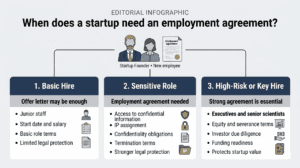
Not every part-time administrative assistant needs a 20-page legal contract, but specific situations may require a formal employment agreement. The moment you cross these thresholds, relying on anything less than a binding contract becomes a major liability:
- First full-time hire: This initial addition sets the precedent for your company culture and dictates your baseline legal risk tolerance.
- Access to protected company information or source code: If an employee can read your clinical trial data or see your client list, an offer letter is entirely insufficient.
- Executive or senior scientist roles: High-level hires bring complex compensation packages involving equity vesting, severance triggers, and performance metrics that must be meticulously documented.
- Before a funding round or due diligence, Institutional investors will closely examine your employment records to ensure your IP is secure before they write a check.
- Regulated industries (life sciences, health tech): Federal compliance standards and the sheer value of your intellectual property magnify the stakes.
By recognizing these critical moments, you ensure the right legal barriers are in place before your confidential data is exposed to direct competitors or the open market.
Employment Agreement Mistakes That Put Startup Founders at Risk
These mistakes often happen when founders move quickly, rely on templates, or assume an offer letter is enough to protect company IP and confidential information.
- Relying solely on an offer letter for key hires: Offer letters rarely include the post-employment protections needed for executives, engineers, researchers, or employees handling protected company information.
- Not including an IP assignment clause: Startups should not assume they automatically own everything an employee creates. Without explicit assignment language, ownership of your core technology can become disputed.
- Using a generic template that ignores local law: Online forms may make restrictive covenants difficult to enforce, especially in states like New York and New Jersey.
- Misclassifying employees as independent contractors: Labeling a full-time worker as a consultant can create tax exposure, wage issues, and government audit risk.
- Omitting data protection and confidentiality provisions: Failing to outline exactly how an employee must handle business-critical information increases the risk of accidental or intentional disclosure.
- Leaving non-compete clauses vague or unenforceable: Drafting overly broad non-compete clauses often renders them legally unenforceable.
Employment Agreement vs Offer Letter
When evaluating an employment agreement vs. an offer letter, it helps to see exactly where the legal protections diverge.
| Feature | Offer Letter | Employment Agreement |
| What it covers | Basic terms: start date, title, salary, and basic benefits. | Comprehensive terms: duties, compensation, restrictive covenants, and termination rules. |
| IP assignment | Rarely included or legally insufficient. | Explicitly assigns all inventions and discoveries to the company. |
| Confidentiality terms | Usually absent or vaguely referenced. | Contains deeply detailed protocols for protecting trade secrets and data. |
| Non-compete clause | Not included. | May be included where enforceable, usually with narrow limits on scope, time, geography, and legitimate business interest. |
| Termination provisions | Merely states employment is “at-will.” | Defines notice periods, severance, and grounds for termination “for cause.” |
| Legal enforceability | Often not considered a binding legal contract. | A fully binding, legally enforceable contract in a court of law. |
| Best used when | Welcoming junior staff who do not handle IP or trade secrets. | Hiring executives, technical talent, scientists, and anyone accessing sensitive information. |
What Happens Without a Proper Employment Agreement?
Without a clear agreement, problems can surface during employee departures, investor diligence, or disputes over ownership of key technology.
Lost IP Ownership
Imagine your biotech company hires a brilliant lead researcher who spends two years developing a novel compound in your lab. Because you never required them to sign a formal IP assignment, they resign, launch a competing startup, and claim personal ownership of the compound they developed.
Without a signed intellectual property ownership agreement explicitly transferring those rights to your company, you will face a costly legal dispute to reclaim the very technology your business was built on.
Failed Investor Due Diligence
Sophisticated venture capitalists and acquirers closely examine employment contracts during the due diligence process. They are looking for clear proof that your company actually owns its technology and that key personnel are bound by strict confidentiality. If agreements are missing, inconsistent, or unenforceable, it raises immediate investor concerns that routinely lower company valuations and frequently derail acquisition deals.
Legal Disputes With Former Employees
Operating without proper contracts exposes you to significant financial risk from misclassified workers, including IRS penalties and unpaid overtime lawsuits. Employees without non-solicitation or confidentiality obligations may contact your clients or recruit your team members without restriction. They could also misuse sensitive business information to compete directly against you.
Key Clauses Every Startup Employment Agreement Must Include
Drafting an effective contract requires far more than copying and pasting standard legalese. Your document must contain specific clauses tailored to the unique risks of the startup ecosystem.
IP Assignment and Invention Ownership
The default legal assumption that a company automatically owns what its employees create, known as the work-made-for-hire doctrine, is not enough to protect a startup. A proper IP assignment clause must expressly state that the company owns all creations.
- All inventions during employment: Must cover all improvements, discoveries, and code developed while employed.
- Off-hours work related to company business: Must include relevant intellectual property developed off-hours or on personal devices.
- Prior inventions disclosure: Ensures the employee clearly lists what they owned before joining, so there is no confusion later.
- Consultants and contractors: These workers do not transfer IP automatically and require entirely separate agreements to ensure your startup retains ownership.
Effective Data Protection Clauses in Employment Agreements
Effective data protection clauses in employment agreements dictate exactly how your team must handle highly sensitive information. These provisions must cover the protocols for securing confidential data, pre-clinical research, and highly guarded trade secrets. For health tech startups, this section is vital for mandating strict HIPAA compliance.
Confidentiality and Non-Disclosure
A confidentiality clause inside a startup employment contract functions differently from a standalone non-disclosure agreement (NDA). A well-drafted agreement must include its own deeply integrated confidentiality obligations tailored to the employee’s daily access.
Relying on a separate NDA alone creates dangerous legal gaps. This is especially true if the NDA expires or lacks provisions covering the specific types of trade secrets the employee handles daily.
Non-Compete and Non-Solicitation
Non-compete clauses prevent departing employees from immediately joining a direct competitor, while non-solicitation clauses block them from poaching your remaining staff or your clients. Geographic location dictates how these are written.
New York has seen recent legislative efforts to restrict non-competes, while New Jersey courts apply strict reasonableness standards. Enforceability varies widely by state, and a qualified attorney should review these terms to ensure they will hold up in court.
At-Will Employment and Termination Clause
At-will employment generally means that either the employer or the employee can end the working relationship at any time, for any lawful reason, subject to applicable contract terms and legal limitations. However, this status still needs to be explicitly documented to prevent wrongful termination claims.
A strong termination clause should specify required notice periods and outline the exact grounds for termination “for cause.” Depending on how your agreement defines “for cause,” termination may allow you to limit or eliminate severance obligations and pause equity vesting, making precise contract language critical from the start.
Severance and Cause Definitions
Vague definitions of what constitutes termination “for cause” create massive legal exposure for your company. If “cause” is poorly defined, firing an underperforming executive will inevitably trigger a bitter dispute over severance payouts. Poorly defined severance terms almost always lead to expensive litigation, draining the capital you need to scale your business.
Employment Agreement Checklist Before Your Next Hire
Before you send an offer to your next critical hire, use this checklist to ensure your company is legally protected from day one.
- Confirm whether you need a full employment agreement or if a simple offer letter is sufficient for this specific role.
- Include a signed IP assignment and invention assignment clause to secure your technology.
- Add confidentiality and data protection provisions that align with your industry’s standards.
- Review non-compete and non-solicitation terms for current enforceability in your state (especially NY/NJ).
- Define “at-will” employment explicitly and document the precise termination procedures.
- Ensure the startup legal agreement covers exactly what happens to unvested equity upon termination.
- Schedule a review with a qualified employment agreement attorney before anyone signs.
- Keep a fully executed, signed copy in your company’s digital legal records for upcoming investor due diligence.
How Crowley Law Helps with Employment Agreements
Crowley Law LLC drafts and reviews tailored employment agreements for life sciences and technology startups. We help founders structure employee and independent contractor relationships correctly before misclassification creates tax or compliance problems. Our team also prepares specific IP assignment, confidentiality, and restrictive covenant provisions tailored for scientific research and designed for local enforceability in New York and New Jersey.
Securing the right contracts early helps prevent ownership disputes, avoid diligence roadblocks, and protect proprietary technology before the company scales. Contact Crowley Law to speak with an employment agreement attorney, whether you need first-hire contracts or a comprehensive employment agreement review.
Contact Us | Schedule a Consultation
Frequently Asked Questions (FAQs)
| Question | Answer |
| What is the difference between an offer letter and an employment agreement? | An offer letter is a brief, informal document outlining basic terms like start date and salary. An employment agreement is a comprehensive, legally binding contract that dictates detailed terms regarding IP ownership, confidentiality, and termination. |
| Does my startup need employment agreements for all employees or just executives? | While executives absolutely require comprehensive contracts, you also need them for any employee handling protected company information. Roles that interact with source code, clinical data, or client lists require formal agreements, whereas junior staff may only need an offer letter and a standalone NDA. |
| What happens in a breach of employment agreement dispute? | A breach of an employment agreement gives your startup legal grounds to pursue remedies. Depending on the nature of the breach, this may include damages, termination for cause, or court orders preventing further disclosure or misuse of confidential information. |
| Are non-compete clauses enforceable in New York and New Jersey? | Enforceability heavily depends on geography. New York has seen recent legislative efforts to restrict non-competes, while New Jersey courts apply strict reasonableness standards and typically only enforce them to protect legitimate business interests. |
| What should an employment agreement include to protect my startup’s IP? | It must include a present-tense assignment of all inventions, discoveries, and improvements made during the employee’s tenure. It should also mandate the prompt disclosure of all inventions and require assistance in securing any necessary patents. |
| When should I hire an employment agreement lawyer to review my contracts? | You should engage legal counsel before hiring your first full-time employee or independent contractor. It is also critical to schedule a review of your existing contracts before entering a funding round, as investors will scrutinize them closely. |